
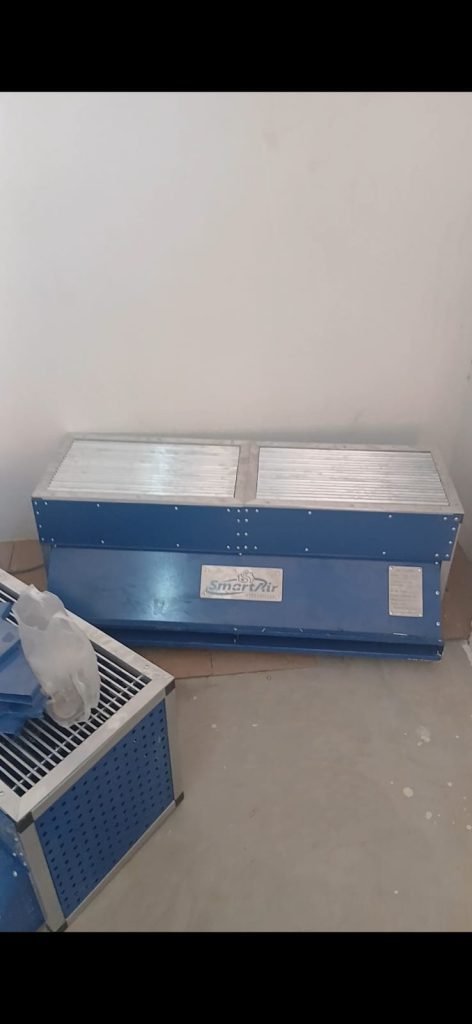
To choose the right industrial air curtain for a factory or warehouse, start with the width and height of the opening, then assess the operating conditions: wind at the opening, the temperature difference between inside and outside, how long the door stays open, and the main purpose of the curtain (cutting loss of conditioned or chilled air, keeping out dust and insects, or both). A curtain narrower than the opening, or too weak for its mounting height, will not form an effective air barrier, whatever its price.
This guide explains step by step how to specify an industrial air curtain for factory openings, warehouses, loading bays, cold rooms and commercial entrances in Egypt, and which mistakes leave a curtain running without doing its job.
How does an air curtain work?
An air curtain is mounted above the opening, or sometimes at its side, and blows a strong, even stream of air downwards across the full width of the opening. That stream forms an invisible barrier that reduces air exchange between inside and outside. Less conditioned or chilled air escapes, and less dust, smoke and flying insects get in, without blocking people, forklifts or goods. The barrier only works if the air reaches the floor with enough velocity and covers the whole width of the opening.
Step 1: start with the opening size
Width
The basic rule is that the curtain, or the combined length of several units, must cover the full width of the opening, ideally overlapping it slightly on both sides. Wide openings use several units mounted side by side with no gaps. Any gap in coverage becomes a path for air, dust and insects.
Height
Mounting height decides how powerful the curtain must be. The greater the distance between the curtain and the floor, the higher the air velocity needed for the stream to reach the floor with enough force. Light commercial curtains suit normal doorways, while tall factory openings need industrial curtains designed for greater heights. Always check the maximum recommended mounting height in the model's datasheet.
Step 2: assess the operating conditions
- Wind at the opening: openings that face the prevailing wind or sit in open areas need a stronger curtain, because wind breaks up the air stream.
- Temperature difference: the bigger the difference between inside and outside, for example an air-conditioned store in an Egyptian summer or a cold room, the more pressure on the air barrier.
- Pressure difference inside the building: strong extract fans inside the plant pull air through the opening and weaken the curtain. They must be taken into account.
- Time the door stays open: an opening that is open all day is very different from one opened for a few minutes. Air curtains pay off most where doors stay open for long periods.
- Type of traffic: people only, or forklifts and trucks, which affects mounting height and automatic control.
- Environment: heavy dust, humidity, fumes or salty coastal air affect the choice of casing material and finish.
Step 3: define the purpose
- Energy saving: in air-conditioned stores, shops and cold rooms, the aim is to keep cold air in and hot air out.
- Keeping out dust and insects: essential in food, beverage and pharmaceutical plants, packing areas and central kitchens.
- Worker comfort: reducing hot or cold draughts at openings near workstations.
- Separating areas: between production and packing zones with different conditions.
Types of air curtain by mounting and heating
| Type | When it fits | Notes |
|---|---|---|
| Horizontal, above the opening | Most doorways and industrial openings | The most common type; must cover the full width |
| Vertical, at the side of the opening | Very tall openings or no space above | Needs a study of air direction and side space |
| Ambient air (no heating) | Most applications in Egypt | Simpler operation and lower power use |
| Electric or water heating | Entrances that need warming in winter | Higher power use; specify only for a real need |
| Cold room models | Cold store and chiller openings | Designed for large temperature differences |
Control and smart operation
To save power and extend motor life, the curtain should run only when the door is open. A door contact switch starts the curtain automatically when the door opens and stops it after the door closes. This works well with rolling shutters, sectional doors and high-speed doors. Multiple speed settings let you adjust the strength by season and wind conditions.
Air curtains with different door types
With a rolling shutter or sectional door, check that the shutter coil or panel tracks will not block the curtain's mounting position or its air outlet. With high-speed doors, the curtain helps during the moments the door is open, especially on cold rooms. Planning the door and the curtain together from the start avoids changes after installation.
Why a site survey matters
A site survey reveals key facts: the real distance from the mounting point to the floor, obstacles above the opening such as a shutter coil or sectional tracks, the prevailing wind direction, nearby extract fans, and the location and type of power supply. These decide the model, the number of units and the fixing method. In most cases the curtain is mounted inside the building directly above the opening, so the barrier sits as close to the door as possible.
Choosing by type of facility
- Food and beverage plants: priority on keeping out insects and dust, easy-clean casings, full-width coverage and automatic control with the door.
- Pharmaceutical and cosmetics plants: as for food, with extra attention to separating clean areas from the rest of the plant.
- Air-conditioned stores and distribution centres: priority on reducing air-conditioning loss at loading bays that stay open during unloading.
- Cold rooms and chillers: models built for large temperature differences, often with a high-speed door to cut opening time.
- Workshops and metal fabrication plants: resistance to dust and particles, and easy cleaning of fans and grilles.
- Shops, restaurants and malls: commercial curtains with a neat appearance and low noise for entrances open all day.
Common mistakes when choosing an air curtain
- A curtain shorter than the opening: air and dust come in at the uncovered edges.
- A light commercial model on a tall industrial opening: the air does not reach the floor and the barrier is weak.
- Mounting the curtain away from the opening: the further from the door, the weaker the barrier.
- Ignoring wind and extract fans: the curtain appears to work but has little real effect.
- Running the curtain 24 hours a day: wasted power; use a door switch or a timer.
- Neglecting cleaning: dirty grilles and fans reduce air velocity over time.
Maintenance and long-term operation
Air curtains need simple but regular maintenance: cleaning the intake grille and fans, checking the motor and connections, and confirming that the door switch works correctly. In dusty plants, cleaning must be more frequent. For any fault, use our after-sales service.
Information we need to recommend a curtain
- Width and height of the opening and the space available above it.
- The type of door fitted (rolling, sectional, high-speed, or none).
- Whether the space is air-conditioned or chilled, and whether there are extract fans nearby.
- Which way the opening faces relative to the wind and the street.
- The main purpose: energy, dust and insects, or both.
- The available power supply and its location.
- Photos of the opening from inside and outside.
Selection steps in summary
- Measure the opening width and choose coverage equal to or slightly wider than it.
- Measure the mounting height and choose a model rated for that height or more.
- Assess wind, temperature difference and extract fans, and allow extra power for difficult conditions.
- Decide the main purpose: energy, hygiene and insect control, or both.
- Choose the control method: door switch, timer, multiple speeds.
- Confirm everything with a site survey before the final order.
If your plant is in food, pharmaceuticals or cold storage, also read: air curtains for food and pharmaceutical factories.
Frequently asked questions about industrial air curtains
Can an air curtain replace a door?
No. It reduces air exchange while the door is open, but it does not provide security, locking or full insulation. It complements the door, especially on openings that stay open for long periods.
How do I know the curtain is powerful enough for the opening height?
Check the model's maximum recommended mounting height in the datasheet and compare it with the real distance from the mounting point to the floor, allowing for wind and temperature difference.
Does an air curtain really keep insects out?
When it is correctly sized, covers the full width and delivers enough air velocity at floor level, it noticeably reduces flying insects. It is part of a pest control system, not the only measure.
Should the curtain be fitted inside or outside the door?
In most cases it is fitted inside, directly above the opening, where it is protected from the weather and close to the door. External mounting is for special cases and needs a suitable model.
Do I need a heated air curtain in Egypt?
Usually not; most applications in Egypt work well with ambient-air curtains. Heating is worth considering only when the entrance area genuinely needs warming in winter.
Want a recommendation for your opening? Browse our industrial air curtains or send measurements and photos through the quote request page.