
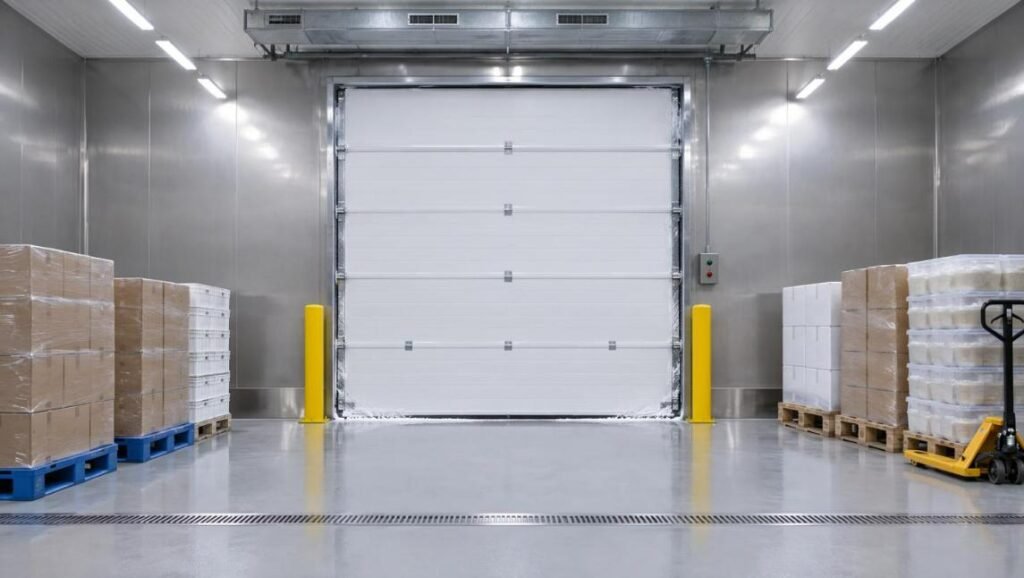
For cold rooms and ripening rooms in food factories, an insulated sectional door is usually the best fit for external openings and room entrances that are opened at intervals, because its insulated panels and perimeter seals reduce the loss of cold air, humidity and ripening gases. A standard roller shutter usually has non-insulated slats and does not seal as tightly, so it suits ordinary dry warehouses better than chilled rooms. A high-speed door suits openings that open and close many times per shift, because it minimises the time the opening stays open. In many factories the best solution is a combination: an insulated sectional door for tight closing, plus a high-speed door or an air curtain for daily forklift traffic.
Cold rooms, banana and fruit ripening rooms and chilled warehouses are among the most sensitive areas in a food factory. Every minute a door stays open lets in warm, humid air, adds load to the refrigeration units, causes condensation and ice on floors and walls, and in ripening rooms disturbs the temperature and gas levels that ripening control depends on. That makes choosing the door part of the cooling system itself, not just choosing an entrance. In this article we compare the common door types, explain where each one fits, and list what to define before requesting a quotation.
What do cold rooms and ripening rooms need from a door?
- Thermal insulation in the door leaf: so the door does not become the weakest point in the room's insulation.
- Perimeter sealing: seals on both sides, the top and the floor, because leakage around the edges can exceed leakage through the door itself.
- Gas tightness in ripening rooms: ripening rooms rely on controlling temperature, humidity and ripening-gas concentration, and a poorly sealed door makes that control harder.
- Short opening times: through a suitable operating speed and automatic closing after each pass.
- Resistance to humidity, condensation and washing: corrosion-resistant, easy-to-clean materials that suit food-safety requirements.
- Forklift traffic: frame protection and safety sensors that prevent collisions.
Insulated sectional doors
A sectional door is made of horizontal insulated (sandwich) panels that run in side tracks and lift up parallel to the ceiling or wall. Its advantages in cold and ripening rooms:
- Insulated panels that reduce heat transfer through the door.
- Seals between panels and around the perimeter and floor that reduce air and moisture leakage.
- Robustness suited to large openings and refrigerated-truck entrances at loading docks.
Its main drawback is that it is slower than a high-speed door, so if the opening is used dozens of times per shift, it stays open longer. It also needs headroom above the opening for the panel track.
Roller shutters
A roller shutter door is made of metal slats that roll onto a drum above the opening. It is economical, durable and good for security. In cold and ripening rooms, however:
- Standard slats are usually not insulated. Insulated slat versions exist, but their sealing is usually still lower than a sectional door.
- Gaps between slats and in the side guides allow more air leakage.
- It is better suited to dry stores, ordinary warehouses and external security openings that are closed at night.
For this reason, a standard roller shutter is generally not recommended as the only door for a chilled room or ripening room. For the general differences between factory door types, see our industrial door types guide.
High-speed doors
High-speed doors use a flexible PVC curtain, or insulated versions designed for cold storage, and move much faster than conventional doors. They open automatically by sensor or radar when a forklift approaches and close after it passes. Their advantages:
- Shorter open time under heavy traffic, which is the most important factor in reducing cold loss when the door is used often.
- Ability to handle a high number of operating cycles per day.
- Some models re-insert the curtain into its guides automatically after a light forklift impact, reducing breakdowns and downtime.
A standard PVC curtain has limited insulation, so for very cold rooms a high-speed door designed for cold storage is chosen, or the high-speed door is combined with an insulated sectional door that is closed at the end of the shift.
Quick comparison: which door for which room?
| Location | Usually the best fit | Why |
|---|---|---|
| Ripening room entrance opened a limited number of times to load and unload batches | Insulated sectional door with good sealing | Insulation and sealing for temperature and gases throughout the ripening cycle |
| Cold room entrance with heavy forklift traffic all shift | High-speed door suited to cold storage, optionally with a sectional door for night closing | Short open times with frequent passes |
| Refrigerated truck loading dock | Insulated sectional door with sealing accessories around the truck | Less leakage during loading |
| Passage between a chilled area and an air-conditioned production hall | High-speed door, or an air curtain with a door | Smaller temperature difference and frequent traffic |
| Non-refrigerated dry store | Roller shutter | Economical, durable and does not need high insulation |
Is an air curtain enough for a cold room?
An industrial air curtain reduces air exchange while the door is open, but it does not insulate the room or seal it. It is therefore not a replacement for the door in cold and ripening rooms, but a complement to it at heavily used openings. We explained its role in air curtains for food and pharmaceutical factories.
Factors that decide your choice
1. Room temperature and the difference with the outside
The larger the difference between the room and the adjacent area, the more insulation and sealing matter. A chilled room next to an open dock in the Egyptian summer is very different from one next to an air-conditioned hall.
2. Number of openings per shift
This decides whether the priority is door speed or insulation, and whether you need two doors on the same opening.
3. Type of traffic
Forklifts, hand trolleys or people. This also determines the width and height of the opening and the safety sensors required.
4. Humidity, condensation and washing
Choose corrosion-resistant materials and easy-to-clean finishes, and consider frame or floor heating in very cold rooms to reduce ice build-up around the door, as recommended by your refrigeration system supplier.
5. Maintenance
Seals wear with use, and any damage cancels the insulation benefit. Include seal checks in the regular maintenance programme, as described in our automatic door maintenance guide.
What information is needed for a quotation?
- Opening dimensions (width and height) and the space available above and beside it.
- Room type: chilled, frozen, ripening or dry store, and its operating temperature.
- What is on the other side of the door.
- Approximate number of openings per shift and the type of traffic.
- Required operation: push button, sensor, radar or connection to the factory control system.
- Factory location and governorate.
How can EGY Trading help?
EGY Trading supplies factories in Egypt with sectional doors, roller shutters, high-speed doors and industrial air curtains, including site survey, installation and after-sales service. Send the details of your rooms and openings through our contact page to get a recommendation and a quotation.
Frequently asked questions
Which is better for ripening rooms: sectional or roller doors?
An insulated sectional door is usually the better fit for ripening rooms, because its insulated panels and seals reduce the loss of temperature and gases, while a standard roller shutter is better suited to non-refrigerated stores.
Are high-speed doors suitable for cold rooms?
Yes, at heavily used openings, because they reduce the time the opening stays open, provided the model suits the room temperature or is combined with an insulated door that is closed at the end of the shift.
Can an air curtain replace the door of a cold room?
No. An air curtain reduces air exchange while the door is open, but it does not insulate or seal the room, so it is used as a complement to the door, not a replacement.
Why does ice form around a cold room door?
Usually because warm, humid air enters through poorly sealed edges or because the door stays open too long, so it condenses and freezes. Checking the seals and shortening open times reduce the problem.
Can the door be installed in an existing cold room?
In most cases yes, after surveying the opening, the headroom above it and the condition of the surrounding walls and floor, and agreeing on the right installation method.