
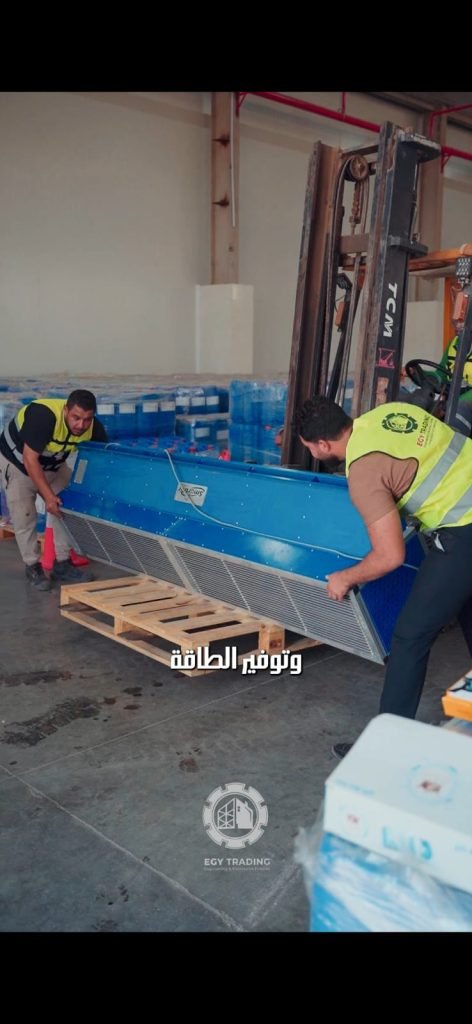
Air curtains in food and pharmaceutical factories are units mounted above door openings that blow a strong, directed stream of air downward, creating an invisible barrier that reduces the entry of flying insects, dust and hot outside air into production, packing and storage halls, while keeping the opening clear for workers, forklifts and goods. They work well when an industrial model is matched to the opening height, covers the full width, is switched with the door, and is part of a complete pest-control and zoning plan rather than a replacement for one.
In food and pharmaceutical plants in Egypt, receiving and shipping doors and the passages between halls stay open for long periods during each shift. With summer heat and dust in industrial zones, every open door becomes an entry point for insects and dust and a source of conditioned or chilled air loss. This article explains where air curtains are used in these factories, what changes in the selection by factory type and area, and what they can and cannot do.
Why do food and pharmaceutical factories need air curtains?
- Fewer flying insects: flies and other flying insects are a major contamination risk in food plants, and a strong air stream makes it harder for them to cross an open doorway.
- Less dust: especially in industrial cities such as 10th of Ramadan, 6th of October and Obour, where dust around factories is common.
- Temperature separation: between the hot outdoors and air-conditioned production halls, or between loading areas and cold rooms and chilled stores.
- Smooth movement: instead of opening and closing the door for every delivery, which slows work or leads workers to leave it fully open.
- Support for hygiene and zoning requirements: expected by food safety systems and good manufacturing practice in pharmaceutical plants, as one part of a wider system.
Where are air curtains installed inside the factory?
| Area | Main goal | Notes |
|---|---|---|
| Raw material receiving doors | Reduce insects and dust | Usually large openings that need a high-throw industrial unit |
| Shipping and loading docks | Reduce conditioned air loss and dust entry | Linked to the rolling or sectional door status |
| Cold room and chilled store entrances | Reduce cold loss, ice build-up and condensation | Must suit the temperature difference; often combined with a high-speed door |
| Passages between production and packing | Separate areas with different hygiene levels | Sometimes installed over conveyor openings |
| Staff entrances and changing rooms | Reduce insects and dust entering with people | Smaller openings, but constant traffic |
What changes by factory type?
Food and beverage plants
The main focus is keeping flying insects and dust out at receiving and shipping doors, and separating production from the outside. Housings and external parts that are easy to clean and resist humidity are preferred, especially in halls that are washed often, and units should be positioned so dust does not collect directly above the production line.
Pharmaceutical and cosmetics plants
The priority is zoning and keeping air pressure and temperature stable in sensitive areas. Coordinate with the HVAC engineer before installation, because the air stream can interfere with the pressure differences designed between rooms. In classified clean areas, an air curtain is not a substitute for doors and airlocks; it is mostly used in receiving, storage and outer corridors.
Meat, poultry, dairy and frozen food plants
Here it is about the cold chain: every time a cold room door opens, warm humid air enters, adding cooling load and causing ice on floors and evaporators. A suitable air curtain reduces this, and it is often combined with high-speed doors for the best result.
How to choose the right air curtain for your factory
- Measure opening height and width: height sets the throw needed for the air to reach the floor, and width sets the length or number of units so no gaps are left.
- Define the main goal: insects and dust, temperature separation, or both, since this affects the model and installation.
- Check the opening conditions: does it face the wind directly, and are there strong extract fans inside that create a pressure difference?
- Choose the control method: link the unit to a sensor or the door status so it runs only when the door is open.
- Plan cleaning and maintenance: in dusty or oily environments, performance drops gradually if intake grilles and fans are not cleaned regularly.
For the general selection criteria see our industrial air curtain selection guide, and for what drives the cost see industrial air curtain prices in Egypt.
The limits: when an air curtain is not enough on its own
- Strong direct wind on the opening: can break the air stream and greatly reduce its effect.
- Crawling insects and rodents: air curtains target flying insects and dust; they do not stop crawling pests or rodents, which need other measures such as door bottom sealing and pest control.
- Full closure or security: outside working hours the door itself must be closed, whether it is a rolling door or a sectional door.
- Classified pharmaceutical areas: need sealed doors and pass-through rooms according to the clean area design.
To compare door types for each opening in a factory, see our industrial door types guide.
Common mistakes in food and pharmaceutical plants
- A commercial unit on a tall industrial door: the air does not reach the floor and the lower part of the opening stays open to insects.
- A unit shorter than the door width: insects and dust come in at the sides.
- Mounting it too far from the opening or at the wrong angle: which weakens the air barrier.
- No regular cleaning: so the unit itself becomes a place where dust collects.
- No coordination with the HVAC system: especially in pharmaceutical plants where the curtain affects pressure differences.
What information is needed for a quotation?
- Factory type (food, pharmaceutical, meat and dairy, frozen food...) and the area where the door is.
- Width and height of each opening, with photos from inside and outside.
- The existing door type: rolling, sectional, high-speed or none.
- The main goal: insects and dust, or temperature and cold separation.
- Approximate hours the door stays open, the industrial city and the opening's exposure to wind.
How EGY Trading can help
We survey your factory openings and recommend the right industrial air curtain model and control method for each door, then supply, install and provide after-sales service and maintenance. Browse our industrial air curtains range and our clients, then send your opening sizes and factory details through the contact page to request a quotation.
Frequently asked questions
Does an air curtain completely stop flies entering a food factory?
It greatly reduces flying insect entry when correctly selected and installed, but it is one part of a wider pest-control system and does not replace closing doors outside working hours and other control measures.
Are air curtains suitable for cold rooms?
Yes. They reduce cold loss and warm humid air entry when the door opens, provided the model suits the temperature difference and opening height; they are often combined with a high-speed door.
Can air curtains be used in pharmaceutical plants?
Yes, in receiving, storage and corridor areas, in coordination with the HVAC engineer. Classified clean areas need doors and pass-through rooms according to their design.
Should the air curtain run all day?
It is better to link it to a sensor or the door status so it runs only when the door is open, which reduces power use and noise and extends fan and motor life.
How often does an air curtain need cleaning in a factory?
It depends on the dust and oil in the area, but intake and discharge grilles should be checked and cleaned regularly as part of the maintenance plan, because dust build-up gradually weakens the air stream.